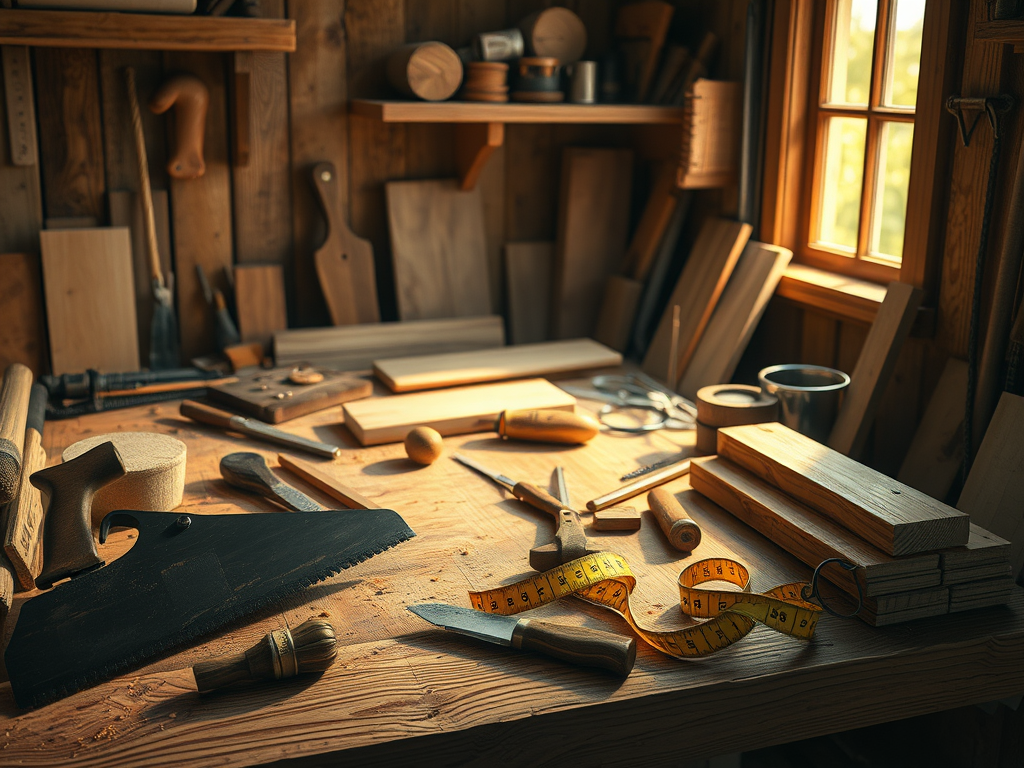
There is a specific, intoxicating magic that happens the moment you step into a woodshop. It’s the scent of freshly sheared pine—sharp and resinous—mingling with the earthy, chocolatey aroma of walnut dust. You run your hand over a rough-sawn board, feeling the rhythmic ridges left by the mill, and you realize: I can turn this into something beautiful.
But for the beginner, the tool aisle can be an overwhelming sea of gleaming steel and high price tags. You don’t need a shop full of industrial machinery to start your journey. To transform a raw plank into a smooth, functional heirloom, you only need a few “soul” tools.
Here is your essential guide to the first tools every woodworker should own.
1. The Measuring Tape and Speed Square
Precision is the foundation of the craft. Before you cut, you must listen to the wood. A high-quality measuring tape should feel heavy and substantial in your palm, with a blade that snaps back with a satisfying metallic thwack.
Pair this with a Speed Square. This solid chunk of aluminum feels cool to the touch and provides a rock-steady 90-degree reference. When you scribe your first line with a sharp pencil, the graphite should glide effortlessly against the metal, leaving a crisp, dark boundary for your saw to follow.
2. The Pull Saw (Ryoba)
While many gravitate toward heavy American-style handsaws, there is a delicate intimacy to the Japanese Pull Saw. Unlike Western saws that cut on the push, the Ryoba cuts on the pull stroke.
As you draw the blade toward you, you’ll feel the teeth bite into the wood fibers with a surgical hiss. Because the blade is under tension while cutting, it can be incredibly thin, leaving a “kerf” (the width of the cut) that is as narrow as a fingernail. It’s a tool that rewards grace over brute force.
3. A Set of Bench Chisels
A chisel is an extension of your hand. For a beginner, a simple set (1/4″, 1/2″, and 1″) is plenty. When properly sharpened, a chisel doesn’t just cut wood; it peels it.
Imagine the sensation of paring a thin shaving of cherry wood—the way the timber curls into a translucent, golden ribbon that smells like autumn. The handle should seat firmly in the crook of your thumb, giving you the control to pare down a joint until it slides together with a perfect, airtight “whoosh.”
4. The Block Plane
If you want to experience the true “sensory” side of woodworking, buy a Block Plane. This small, palm-sized tool is used to chamfer edges and smooth end-grain.
Adjusting the blade is a tactile ritual. You’ll hear the pitch of the tool change as it engages the wood—from a hollow scratch to a deep, melodic shuck. When the blade is set just right, it produces shavings so thin they float in the air like lace, leaving behind a surface so reflective it feels like polished silk.
5. Random Orbital Sander
We often dream of the “hand-tool only” life, but the reality of finishing involves sanding. A Random Orbital Sander is your best friend.
As it hums in your hand, you’ll watch the rough, fuzzy texture of the wood vanish. It’s a transformative process: the dull, dusty surface slowly wakes up, revealing the shimmering “chatoyancy”—that cat-eye glow—hidden deep within the grain.
6. Clamps (The “Silent Partners”)
You can never have too many, but start with four 6-inch F-style clamps. They provide the muscular squeeze needed to hold a glue-up together. There is a profound sense of closure when you tighten a clamp and see tiny beads of glue “squeeze out” from the joint, signaling a bond that will likely outlast the house it sits in.
Key Take away: Start Small, Build Deep
Your first shop shouldn’t be a museum of expensive gadgets. It should be a sanctuary of focused intent. Start with these few essentials, and you’ll find that the most important tool isn’t made of steel or iron—it’s the calloused skin on your palms and the quiet confidence that comes from turning a tree into a treasure.
Are you ready to make your first cut?